

Keep in mind
The Defence and Security Division has undertaken various activities in line with the Women, Peace and Security Agenda. The Division has mainstreamed gender in key documents and policies and has produced operational guidance notes on gender mainstreaming in key sectors:
Gender Mainstreaming in Peace and Security
The Defence and Security Division has undertaken various activities in line with the Women, Peace and Security Agenda. The Division has mainstreamed gender in key documents and policies and has produced operational guidance notes on gender mainstreaming in key sectors:
Steps for the operationalization
The Defence and Security Division has undertaken various activities in line with the Women, Peace and Security Agenda. The Division has mainstreamed gender in key documents and policies and has produced operational guidance notes on gender mainstreaming in key sectors:
Gender Based Violence
Gender refers to the roles, behaviours, activities, and attributes that a given society at a given time considers appropriate for men and women. In addition to the social attributes and opportunities associated with being male and female and the relationships between women and men and girls and boys, gender also refers to the relations between women and those between men. These attributes, opportunities and relationships are socially constructed and are learned through socialization processes. They are context/ time-specific and changeable. Gender determines what is expected, allowed and valued in a woman or a man in a given context. In most societies there are differences and inequalities between women and men in responsibilities assigned, activities undertaken, access to and control over resources, as well as decision-making opportunities. Gender is part of the broader socio-cultural context, as are other important criteria for socio-cultural analysis including class, race, poverty level, ethnic group, sexual orientation, age, etc.
Gender-based crimes
Gender-based crimes‛ are those committed against persons, whether male or female, because of their sex and/or socially constructed gender roles. Gender-based crimes are not always manifested as a form of sexual violence. They may include non-sexual attacks on women and girls, and men and boys, because of their gender (ICC, 2014).
Sexual Crimes
Sexual Crimes of sexual violence can include:
- different forms of penetrative rape, sexual slavery, forced prostitution, forced pregnancy and forced sterilisation or abortion.
- Crimes of sexual torture, sexual humiliation and forced nudity may likewise constitute sexual violence.
- Gender-based violence, in its widest sense, may be understood as persecution on the basis of gender and can include a variety of crimes (Justice Hub)
- An act of a sexual nature is not limited to physical violence, and may not involve any physical contact — for example, forced nudity. Sexual crimes cover both physical and non-physical acts with a sexual element.
Prosecuting SGBV
At the International Criminal Court (ICC) charges for SGBV can either be brought as crimes per se, or as forms of violence such as rape as torture. Additionally, acts of SGBV can be charged as different categories of crimes and can thus constitute crimes against humanity, war crimes or may amount to genocide.
SGBV may be charged as crimes against humanity when committed “as part of a widespread or systematic attack directed against civilian populations”.
Sexual and Gender based Violence (SGBV)
Sexual violence is a form of gender-based violence and encompasses any sexual act, attempt to obtain a sexual act, unwanted sexual comments or advances, or acts to traffic, or otherwise directed against a person’s sexuality using coercion, by any person regardless of their relationship to the victim, in any setting. Sexual violence takes multiple forms and includes rape, sexual abuse, forced pregnancy, forced sterilization, forced abortion, forced prostitution, trafficking, sexual enslavement, forced circumcision, castration and forced nudity. ( Office of the High Commissioner for Human Rights - OHCHR)
Extract from UN Security Council Resolution 2272 (2016)
2. Requests the Secretary-General, when a particular troop-contributing country whose personnel are the subject of an allegation or allegations of sexual exploitation and abuse has not taken appropriate steps to investigate the allegation and/or when the particular troop- or police-contributing country has not held the perpetrators accountable or informed the Secretary-General of the progress of its investigations and/or actions taken, to replace all military units and/or formed police units of the troop- or police-contributing country in the United Nations peacekeeping operation where the allegation or allegations arose with uniformed personnel from a different troop- or police-contributing country, as applicable and further requests the Secretary-General to ensure that the replacement troop- or police-contributing country has upheld standards of conduct and discipline and appropriately addressed allegations against or confirmed acts, if any, of sexual exploitation and abuse by its personnel
9. Urges all Member States to take concrete steps aimed at preventing and combating impunity for sexual exploitation and abuse by members of United Nations peace operations;
10. Welcomes the ongoing efforts by Member States to strengthen sexual exploitation and abuse pre-deployment training of troop and police contributors to United Nations peace operations, urges further efforts by all troop- and police contributing countries to deliver robust sexual exploitation and abuse pre-deployment training in accordance with the terms of their memoranda of understanding and other agreements with the United Nations, encourages further assistance by Member States and multilateral partners to troop- and police contributing countries in this regard and welcomes the decision of the Secretary General to require certificates of compliance by troop- and police-contributors to this effect;
11. Urges all troop-contributing countries to take the steps necessary to conduct investigations of allegations of sexual exploitation and abuse by their personnel and to conclude such investigations as expeditiously as possible, in line with the Secretary-General’s request, further urges all troop- and police-contributing countries to take appropriate steps to hold accountable those personnel responsible for sexual exploitation and abuse and to report to the United Nations fully and promptly on actions undertaken and welcomes the request by the Secretary-General for troop- and police-contributing countries to deploy national investigation officers in their contingents to support these efforts;
UNSCR 2272 (2016)
Definition of Sexual Exploitation and Abuse (SEA)
According to the African Union Policy on prevention and response to the Sexual Exploitation and Abuse of 2018, Sexual abuse refers to any action or behaviour of a sexual nature that coerces, threatens or forces a person to engage in a sexual activity (penetrative and non-penetrative), that they would not otherwise have engaged in, and often without being able to give their consent. Sexual abuse includes the actual or threatened physical intrusion of a sexual nature, and occurs under coercive conditions, which are often reflective of unequal power relations and harmful behaviour.
Sexual exploitation is the inducement, incitement, coercion and compelling of another person to undertake a sexual activity through abuse of a position of vulnerability, differential power, dependency or trust. Sexual exploitation includes, but is not limited to, exploiting material, monetary, social, psychological and political advantages to induce a person to engage in a sexual activity. In this context, sexual exploitation applies not only to actual sexual activity but also to an attempt to engage in such activity. An act of sexual exploitation occurs when the particular person would have had no substantial option, and no reasonable choice but to succumb to pressure to engage in a sexual activity. Sexual exploitation is harmful and exploitative behaviour which occurs in the context of hierarchical interactions and relationships.
Acts that constitute SEA are prohibited behaviour and include acts outlined in paras (a) to (d). Some of the acts outlined can be overlapping (e.g. exchange of money, employment, goods and services for sex, and transactional sex):
- Exchange of money, employment, goods or services for sex, including sexual favours or other forms of humiliating, degrading or exploitative behaviour is considered to be sexual exploitation and is therefore prohibited. This includes any exchange of assistance that is due to the local population, participants and/or beneficiaries of assistance, for sex.
- Any action or behaviour of a sexual nature that coerces, threatens or forces a person to engage in a sexual activity (penetrative and non-penetrative) is considered to be sexual abuse. Sexual abuse of the local population, participants and/or beneficiaries of assistance is prohibited.
- Sexual activity involving children of the local population, participants and/or beneficiaries of assistance is prohibited, regardless of the age of majority or age of consent locally. Mistaken belief as to the age of a child is not a defence.
- Transactional sex is prohibited, since it is based on inherently unequal power dynamics. Such relationships undermine the integrity and credibility of Mission Personnel, PSOs and the AU at large.
Definition of transnational sex
Transnational sex refers to
- The exchange of money, employment, goods or services for sex, including sexual favours other forms of humiliating, degrading or exploitative behaviour. This includes any exchange of assistance that is due to beneficiaries of assistance.
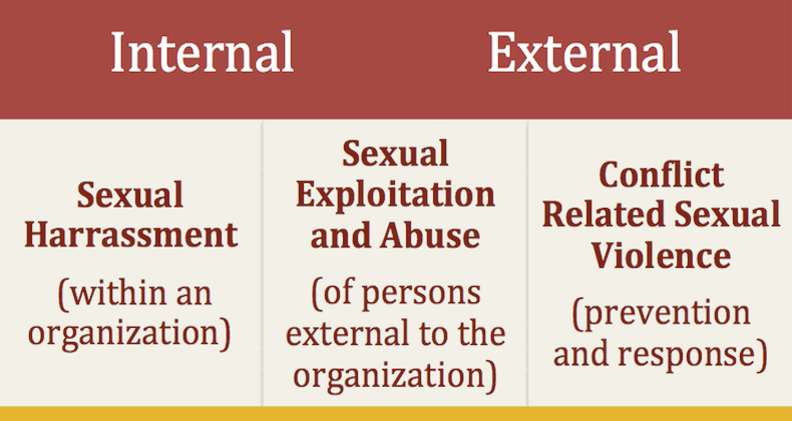
Differences Sexual Explotation and Abuse, Sexual Harassment and CRSV
Definition of Sexual Harassment
Sexual harassment includes such unwelcome sexually determined behavior as
- physical contact and advances,
- sexually coloured remarks,
- showing pornography and sexual demands, whether by words or actions.
(Source: Committee on the Elimination of Discrimination against Women, General Recommendation 19, Violence against women (Eleventh session, 1992), U.N. Doc. A/47/38 at 1 (1993))
Gender Mainstreaming
Gender refers to the roles, behaviours, activities, and attributes that a given society at a given time considers appropriate for men and women. In addition to the social attributes and opportunities associated with being male and female and the relationships between women and men and girls and boys, gender also refers to the relations between women and those between men. These attributes, opportunities and relationships are socially constructed and are learned through socialization processes. They are context/ time-specific and changeable.