Porto
  • Welcome
  • AU Peace and Security Department
  • Women Peace and Security
    • Women, Peace and security Agenda
    • Regional African Commitments on WPS
    • African Union Women Peace and Security Framework
    • United Nations Security Council Resolutions on Women Peace and Security
    • AU Member States Implementation of UNHCR 1325
  • Gender Concepts
  • Conflict-related Gender concepts
    • Gender based violence
    • Sexual and Genderbased violence
    • Sexual Exploitatoin and Abuse
    • Sexual Harassment
    • Transactional Sex
    • Trafficking of persons for sexual exploitation
  • Gender Mainstreaming in PSD
    • Gender Peace and Security Programme 2015-2020
    • Gender task force
    • Office of the Special Envoy on Women,Peace and Security
    • Femwise africa
    • Peace and Security Council
  • Good Practices
    • AU Peace and Security Department
    • AU Missions
    • AU Liaison Offices
  • AU PSD thematic Areas
    • Disarmament Demobilization and Reintegration
    • Small Arms and Light Weapons
    • Security Sector Reform
  • Capacity Building tools
    • Gender mainstreaming capacity needs assessment
    • Gender bite
    • Self-Assessment on Gender, Peace and Security

© 2025 AU PSD

  • Access to External Resources

Contact Home

Methodology

The Gender Mainstreaming Capacity Needs Assessment was developed both in English and in French and comprises 18 questions in multiple-choice and open answer format. The information provided is confidential and anonymous unless otherwise indicated, in order to allow respondents to express freely their opinions. The survey was distributed both electronically and manually to PSD staff from HQ, AULOs and AU Missions and results have been collected from July 2018 till September 2018. 

 Collection of results

  • the results have been collected from July 2018 till September 2018.
  • the total number of survey collected is 86.

The assessment is divided into five main categories:

  • Profile of the respondents to the survey
    • In which Division/Unit/AULOs or Mission do you work?
    • What is your position level?
    • Do you think it is important to incorporate a gender perspective in your work?
  • Knowledge on gender mainstreaming and WPS
    • How would you describe your level of understanding of the following concepts, and would you like to know more about them (Gender analysis, gender mainstreaming, WPS agenda and gender indicators?
    • How familiar are you with the UN Resolutions on Women, Peace and Security?
    • How familiar are you with the AU policy framework on Women, Peace and Security?
    • Do you consult the Gender Focal Point in your Division?
  • Training needs
    • Have you received any training on gender issues?
    • If yes, which type of training, and which topic?
    • Would you like to participate in training about gender mainstreaming and Women, Peace and Security?
    • Which specific topics would you like to discuss in the training?
  • Gender mainstreaming practices
    • What would you suggest are key priorities for PSD to ensure in regards to mainstreaming gender in its work?
    • Could you briefly explain how gender is mainstreamed in your work
    • Do you use guidance documents on gender mainstreaming (such as guidance document on gender mainstreaming in SSR, CEWS...) or gender analysis in your work?
    • If not, would you like to receive support in mainstreaming gender in the work of your Division, such as guidance documents and/or tools?
    • What kind of support do you need to mainstream gender and incorporate the Women, Peace and Security agenda in your work?
  • Sharing best practices 
    • How do you assess and share best practices in your unit/Division?
    • Would you like to have access to a knowledge platform where to find best practices, documents, lesson learnt on gender mainstreaming in PSD work?

 

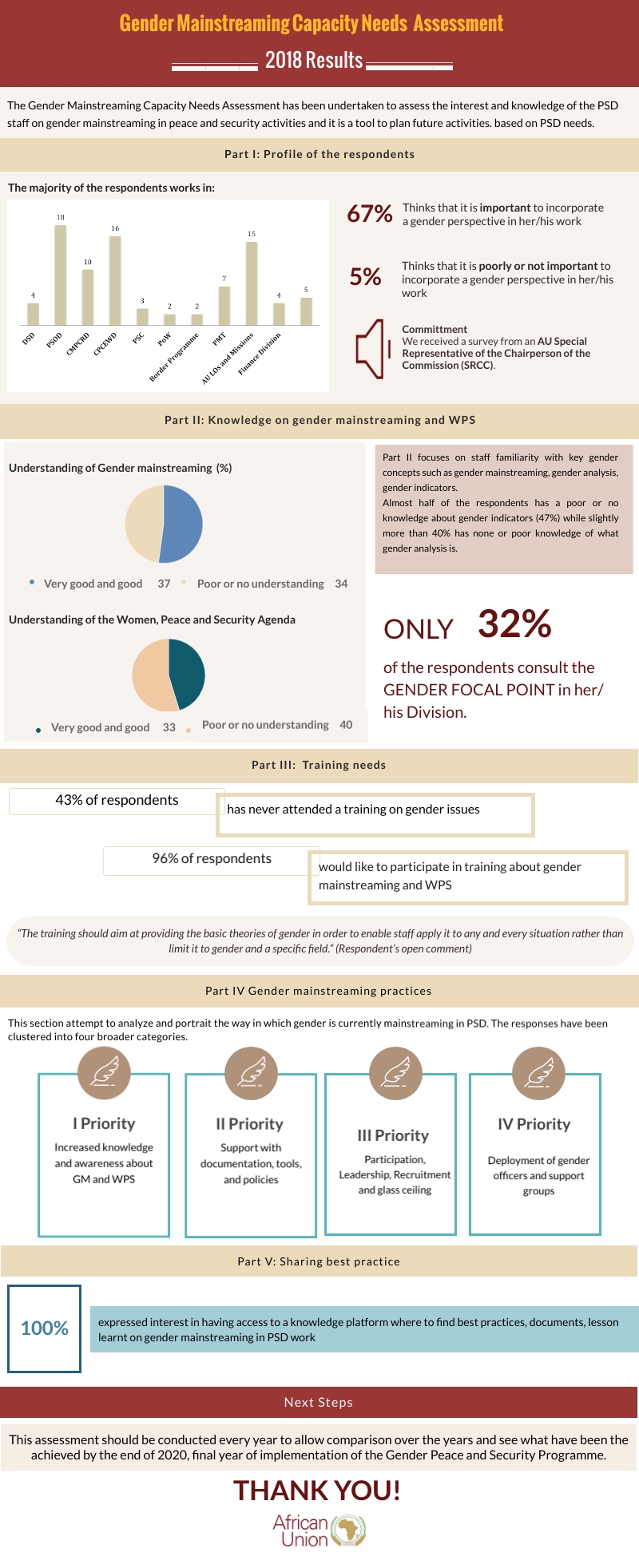
Some results

...

Conclusions

The assessment has shown that:

  • there has been high interest in responding to the questionnaire from a large variety of staff, belonging to various divisions and position level.
  • there is the need to strengthen the structure dedicated to gender mainstreaming and to the implementation of the Women Peace and Security Agenda. The role of the Gender Taskforce should be more recognized as contact point for improving the quality and quantity of gender mainstreaming.
  • focus needs to be placed on aspects of capacity building as almost 60% of the respondents have never received training on gender issues.
  • The areas were there is greater needs of capacity building are gender indicators and gender analysis. On the contrary, the area where there is the most knowledge about is gender mainstreaming.
  • As regards to thematic trainings, the areas where staff has expressed interest in are (from the most to the least required):
    1. Women’s role in mediation, peace-building, peacekeeping
    2. Concepts: what’s gender mainstreaming, Results based indicators for gender, the Women Peace and Security Agenda etc.
    3. Human Rights Based Approach and Gender Mainstreaming
    4. Gender problem analysis and the chain of result for project and program design
    5. Gender mainstreaming in Post conflict reconstruction
    6. Gender mainstreaming in Early warning
    7. Gender mainstreaming in SSR.
  • Ensure that information available on gender methodology and tools are well disseminated and remain easily available (electronically) to facilitate gender-mainstreaming work. This platform has been developed for this purpose.


Gender mainstreaming capacity needs assessment

Between July and October 2018, as part of the implementation of the Gender Peace and Security Programme, the AU Peace and Security Department undertook a “Gender Mainstreaming Capacity Needs Assessment” to map out the institutional capacities for gender mainstreaming and the implementation of the Women, Peace and Security (WPS) Agenda in the Department.

The results of the assessment are used to plan activities for capacity building and information sharing on gender mainstreaming and WPS at the institutional level. What emerges from the survey is valuable for defining ways to support the PSD staff, especially for the implementation of the Gender Peace and Security Programme for the period 2018-2020. It helps to understand where action is required to make sure that commitments on WPS are matched with internal capacity to implement them and that the right support provided to staff in order to pursue the WPS agenda within their work.

  • Resources
  • Useful Links
  • Report of the PSD Gender Mainstreaming Capacity Needs Assessment (October 2018)
    18,Nov 2020 00:37:15
  • Infographic on the of the results of the PSD Gender Mainstreaming Capacity Needs Assessment
    18,Nov 2020 00:30:17

No Resource Found

    No Usefull Link Found